
僵尸先生
China-US basketball exchange brings young players together on and off court_我的网站

A |
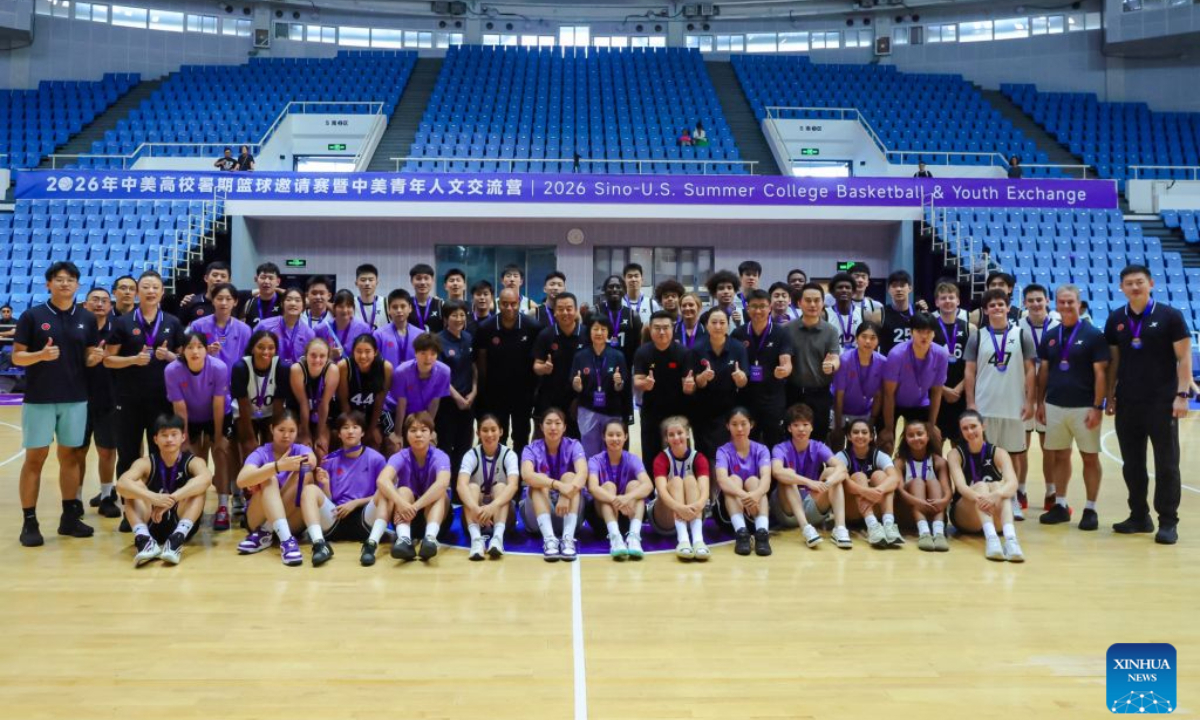
On the basketball court, young players from the two countries came together as teammates, rather than competitors.
The basketball games, held at Tsinghua University's sports complex in Beijing over the weekend, featured 16 U.S. players teaming up with their Chinese peers in separate men's and women's games, with players from both countries mixed on each team.
The games were a highlight of the 2026 Sino-U.S. Summer College Basketball & Youth Exchange, a six-day program that brought together U.S. students from universities including Stanford University, Harvard University and Yale University.
Co-hosted by China Center for International People-to-People Exchange (CCIPE) under the Ministry of Education and Tsinghua University, the program combines basketball competitions with activities including campus tours and cultural experiences to deepen exchanges, cultivate sportsmanship, and promote communication, understanding, friendship, and cooperation among younger generations on both sides.
"I'm so excited," said Lily Brown, a 20-year-old student from Bates College, after her team won. "Everyone had really good hustle, and everyone was attacking the basket really well and shooting with confidence."
After training with her Chinese teammates for several days, Brown said that despite the language barrier, they shared much in common, from movies and entertainment to social media.
"We communicate through basketball," she added.
That shared language is at the heart of the program's mixed-team format, according to J.R. Carnegie-Hargreaves, the U.S. delegation's team leader.
"The shared pursuit of basketball creates a common ground, and from that, mutual trust and friendship take root," he said.
The idea of using sports to bring people together has a long history in China-U.S. relations. In 1971, a U.S. table tennis team made a historic trip to China, marking the reopening of channels for friendly people-to-people exchanges between the two countries.
This April, Chinese and American young people gathered for events marking the 55th anniversary of Ping-Pong Diplomacy.
Today, young people are increasingly seen as vital bridges in bilateral relations. Deputy Director-General of the CCIPE Cao Diefeng said at the opening ceremony that the program was designed to help young people from both countries not only get to know each other on the court but also step into each other's thoughts and daily lives.
"Through firsthand experiences of the development story, cultural heritage and social landscape of each other's countries, they may come to see each other in a truer, fuller and more vivid light," he added.
China launched an initiative in November 2023 to invite 50,000 young Americans to visit the country for exchange and educational programs over five years. According to China's Ministry of Foreign Affairs, more than 50,000 young Americans have since visited China, reaching the target two and a half years ahead of schedule.
For many young Americans, the chance to explore China is an experience in itself. Jason Singleton, an 18-year-old student from Harvard University, said that he felt "blessed" to join the exchange program. It was his first trip to China after studying Chinese for about six years.
"Not everybody in America gets the chance to see the Great Wall," he said, delighted to get immersed in the Chinese culture during the journey.
For Cuyler Sparks, a high school student at Choate Rosemary Hall, the chance to learn more about Chinese basketball while exploring the country was one she couldn't "say no" to.
On her first trip to China, time spent with her Chinese teammates has been just as memorable, especially trying local foods. Roast duck quickly became her favorite dish.
"We don't know what some of the things are, so they explain to us how to eat them and what's really good," she said. "Just being together and trying to figure things out, even with the language barrier, has been really fun."
For some participants, the exchange was more than just a first encounter; it was a chance to continue a friendship that had already begun.
Xi Taicheng, a senior student from Tsinghua University who joined the event two years ago, was glad to meet some familiar faces again this time.
"Playing alongside the U.S. players was always a refreshing experience," he said. During several days of joint training, they chatted about their studies, training and the Chinese Basketball Association (CBA), with the Americans curious about life and basketball in China.
"I've made more new friends this time and added almost all the players on the U.S. men's team on social media," Xi said. "It's been really fun chatting and spending time together."
。 8 月 26 日消息,OpenAI 昨日(8 月 25 日)发布博文,展示其首款自研 Jalapeño 芯片,并表示无论是单用户 token 处理量,还是每千瓦吞吐量,都超过了目前市面上的顶尖推理处理器。在官方博文中,OpenAI 使用半导体研究公司 SemiAnalysis 开发的公共基准测试工具 InferenceX,通过 GPT-OSS 120B、DeepSeek R1 670B 和 Kimi K2.5 1T 三款模型测试。测试显示对比市面上领先的 AI 系统(GB200 和 GB300),每瓦能够完成的 AI 吞吐量是对比系统的 1.5 至 1.9 倍,端到端延迟则约为对比系统的 28% 至 59%。

B | 混合 Token 吞吐量与现有 AI 加速器的最快解码速度对比3 款模型峰值单用户解码吞吐量各平台最佳运行点的混合 Token 峰值吞吐量OpenAI 表示,Jalapeno 在运行 GPT-OSS 120B 时,每千瓦的峰值吞吐量比 GB200 系统高出约 1.9 倍。在 DeepSeek R1 上,它的每瓦性能比 GB300 高出约 1.7 倍;在 Kimi K2.5 上,它的每瓦性能比 GB300 高出约 1.5 倍。Jalapeno 的额定功率为 700 瓦,但在测试工作负载期间,其持续功耗保持在 550 瓦或以下。附上相关图片如下:延伸阅读Jalapeño 是 OpenAI 首款自研 AI 推理芯片,由 OpenAI 与博通(Broadcom)合作开发,台积电采用 3nm 制程代工制造,于 2026 年 6 月 24 日首次对外展示。该芯片是一颗 ASIC(专用集成电路),采用 systolic array(脉动阵列)架构,配备 HBM 高带宽内存,专为大语言模型推理场景设计,不用于模型训练。芯片及配套服务器系统均不会对外销售,仅供 OpenAI 内部使用,旨在降低自身 GPU 采购和算力运营成本。OpenAI 硬件负责人 Richard Ho 领导了该芯片的研发,他此前在 Google 工作近九年,是 Cloud TPU 项目的核心工程师。

C | Jalapeño 从架构设计到完成流片仅耗时约 9 个月,OpenAI 称这是高性能先进半导体领域有史以来最快的 ASIC 开发周期之一。OpenAI 自身的 AI 模型也深度参与了芯片设计流程,帮助加速设计优化。

D | 目前第二代 Jalapeño 芯片已进入后期开发阶段,预计未来数月内完成流片;第三代芯片也已启动概念设计。OpenAI 计划于 2026 年年底前小规模部署 Jalapeño,2027 年逐步扩大部署规模。需要注意的是,Jalapeño 此次测试对比的对象为英伟达 GB200 和 GB300 系统,尚未与英伟达最新一代 Vera Rubin 芯片进行对比测试。OpenAI 表示英伟达仍是其重要合作伙伴,未来将持续采用多供应商策略以满足庞大的算力需求。相关阅读:。
Current article:http://t4sj.linlangdouwaqiexusan.bond/k7goa/20260826/4117.html
Published on:03:53:18


1
2022短道速滑国家训练营正式开营 张晶任总顾问2
네팔 홍수에 한국인 8명 연락두절…두산·남동발전 긴급 대응3
【盟·全环境立德树人】吉祥味·穿梭在民俗里的中国年—即墨区盟旺路幼儿园、棠邑路园区大班级部喜迎蛇年活动4
全新奔驰GLC纯电版将于9月慕尼黑车展发布 MB.EA平台首款车型5
都体:伊尔迪兹手术恢复期约三个月,他最早能在11月重返赛场6
公开站队!佩蒂特等人呼吁改革国际足联,萨内蒂等人声明支持FIFA7
TikTok Shouldn’t Be TikDoc8
大回调甚至跌停!乙二醇的支撑消失了?9
热议!郑钦文0-2输球无缘四强,比赛暴露出不少问题,你怎么看?10
闪小融APP放款扣会员费还索要好处费我要退钱11
丽水市举办福彩公益金资助项目开放日活动12
在抖音电商下单10天未发货店铺已下架产品怎么处理13
抚顺县:全力出击清冰雪14
国产大模型改写全球AI调用版图15
Iraqi man arrested in Germany over alleged involvement in war crimes as a member of IS
- 随机推荐
1
民建济南市第十三次代表大会开幕2
完成上一代人的遗憾:索尼X800m2蓝光播放器最终支持杜比的地平线3
8月24日中国人民银行开展3400亿元7天期逆回购操作4
Box Office Report: Dhurandhar Continues Its Glorious Run on Day 65
日赚2亿的宁德时代,为何跑输大盘?6
今年二季度,云南省以工代赈带动24.24万名群众就业增收7
河北鼓励错峰度假:预计将迎来2.5天的短、长假期。8
北京越野泰钽 700 上市:搭载华为乾崑智驾 ADS 5,超级焕新价 24.98 万元起9
美国造芯片,贵得吓人10
请3休13!“超长假期”马上来了11
专家:勃利东北虎或为捕捉家畜进村,成年虎能轻松扑倒一头牛12
四川马边县极端强降雨引发山洪,有车辆被冲到墙体上悬挂13
1.5B开源通用VLA模型,冲进具身智能第一梯队14
南京众彩蔬菜市场:对场内大白菜地毯式抽检,未检出甲醛等有害物质15
立足创新发展 多方加快建设高质量知识产权生态